
The Privacy Briefing
The Privacy Briefing
Practical insight at the intersection of data, AI, and human autonomy.
The Privacy Briefing examines the systems reshaping digital autonomy worldwide. It focuses on how AI models capture and recombine human-generated data, how governance failures become structural risks, and how dependence on global platforms is redefining control for individuals, organizations, and nations.
The reality behind today’s AI boom is straightforward: systems are collecting unprecedented amounts of data, inferring more than most people realize, and making decisions that are rarely visible. Organizations adopt tools that promise efficiency but quietly transfer intellectual property into external training pipelines. Governments rely on models that reflect values they did not design. Individuals are left unsure how their digital lives are being interpreted or repurposed.
We address these developments directly, explaining how data is used, how platform power consolidates, and why governance gaps persist across sectors and jurisdictions. Each edition offers clear, grounded analysis to help readers interpret rapid technological change and make informed decisions in an environment where AI’s consequences are expanding faster than public understanding.
Privacy Briefing Report
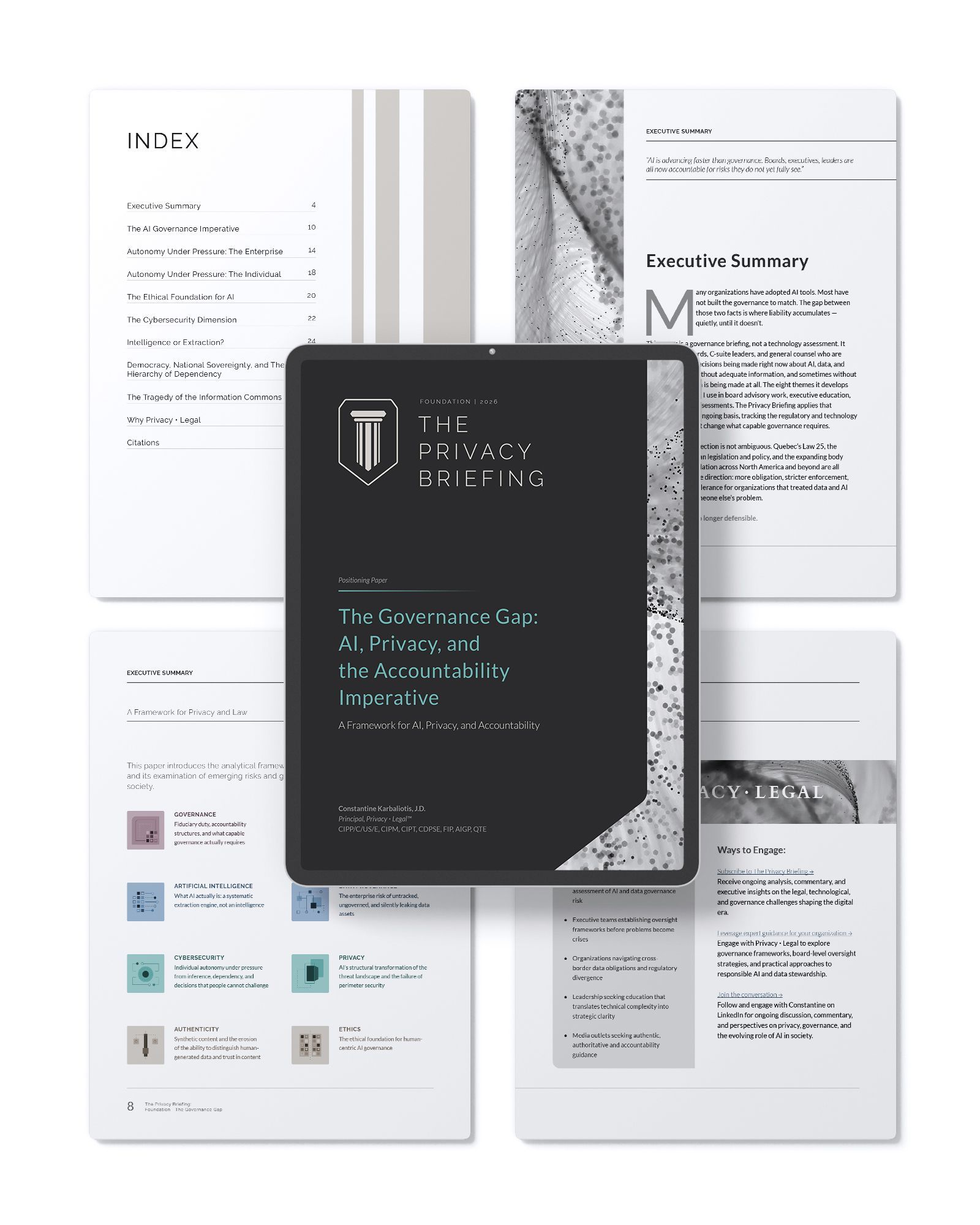
The Governance Gap: AI, Privacy, and the Accountability Imperative
The Governance Gap: AI, Privacy, and the Accountability Imperative is the inaugural issue of The Privacy Briefing, a new series examining the legal, technological, and governance challenges emerging in a data-driven world.
This first volume introduces the analytical framework that guides the series. It reframes artificial intelligence not as a form of machine “intelligence,” but as a global system built on the extraction and processing of human-generated data. As organizations integrate AI tools into everyday operations, vast quantities of institutional knowledge, personal information, and public-sector data are increasingly absorbed into training systems that organizations cannot fully see, control, or audit.
The paper examines how these dynamics are reshaping risk across multiple levels of society. Individuals face new forms of inference and decision-making based on data they may never have knowingly shared. Organizations risk the silent transfer of intellectual property and strategic knowledge into external platforms. Governments confront growing dependencies on digital infrastructure and AI ecosystems beyond their jurisdictional control.
Drawing on decades of experience in privacy law, cybersecurity, and governance, Constantine Karbaliotis outlines why traditional oversight models are struggling to keep pace with these developments. The paper establishes a framework for understanding how autonomy, accountability, and data sovereignty are being redefined in the age of AI, and why leadership teams must begin treating these issues as matters of governance rather than simply matters of technology.
As the first issue of The Privacy Briefing, this paper sets the foundation for an ongoing series that will explore emerging risks, governance failures, and practical strategies for navigating the digital era.
What You’ll Gain from the Privacy Briefing
The Privacy Briefing provides ongoing insight into the issues shaping digital autonomy—ranging from long-term structural trends to the events and decisions influencing the sector week by week. While the positioning paper establishes the broader framework, the Briefing itself moves across a wide spectrum of topics: governance failures that surface in the news, regulatory updates with practical consequences, unexpected shifts in platform behaviour, emerging risks in AI deployment, and patterns that reveal where institutions may be losing visibility or control.
AI Systems and Data Extraction
Clear analysis of how AI models collect, infer, and repurpose human-generated content—and what that means for autonomy, accountability, and long-term risk.
Privacy, Surveillance, and Individual Rights
Examination of how personal data is captured, shared, and interpreted across public and private systems, including the implications for identity, consent, and digital self-determination.
Corporate Governance and Organizational Risk
Insight into how organizations lose visibility and control over their intellectual property, operational data, and decision-support systems through platform reliance and poorly structured governance.
Regulatory and Legal Developments
Interpretation of new laws, enforcement actions, and policy shifts across jurisdictions, with a focus on practical obligations and emerging compliance challenges.
AI Systems and Data Extraction
Clear analysis of how AI models collect, infer, and repurpose human-generated content—and what that means for autonomy, accountability, and long-term risk.
Privacy, Surveillance, and Individual Rights
Examination of how personal data is captured, shared, and interpreted across public and private systems, including the implications for identity, consent, and digital self-determination.
Corporate Governance and Organizational Risk
Insight into how organizations lose visibility and control over their intellectual property, operational data, and decision-support systems through platform reliance and poorly structured governance.
Regulatory and Legal Developments
Interpretation of new laws, enforcement actions, and policy shifts across jurisdictions, with a focus on practical obligations and emerging compliance challenges.
Platform Power and Digital Dependency
Commentary on the influence of dominant technology providers, including how access to data, compute, and model infrastructure is reshaping global power dynamics.
National and Global Sovereignty Concerns
Exploration of how AI, cloud platforms, and cross-border data flows affect state autonomy, geopolitical relations, and the long-term viability of public institutions.
Data Governance Failures and Systemic Weaknesses
Breakdowns of incidents, audits, or operational gaps that expose deeper structural flaws—and how those flaws scale when embedded into automated systems.
Emerging Risks, Trends, and Public Events
Timely responses to new threats, high-profile incidents, technological shifts, and sector-specific developments that carry broader implications for digital ecosystems.
Platform Power and Digital Dependency
Commentary on the influence of dominant technology providers, including how access to data, compute, and model infrastructure is reshaping global power dynamics.
National and Global Sovereignty Concerns
Exploration of how AI, cloud platforms, and cross-border data flows affect state autonomy, geopolitical relations, and the long-term viability of public institutions.
Data Governance Failures and Systemic Weaknesses
Breakdowns of incidents, audits, or operational gaps that expose deeper structural flaws—and how those flaws scale when embedded into automated systems.
Emerging Risks, Trends, and Public Events
Timely responses to new threats, high-profile incidents, technological shifts, and sector-specific developments that carry broader implications for digital ecosystems.
Each edition approaches these developments with the same clarity and grounded analysis, but the focus evolves based on what matters most in the moment. Whether examining a legislative change, a data breach with systemic implications, a new form of inference risk, or a geopolitical concern related to digital sovereignty, the Briefing helps readers understand why it matters and how it fits into the larger shift toward data-driven dependency.
The result is an adaptable, informed resource for leaders who need to interpret an environment that changes quickly—and often without warning.
